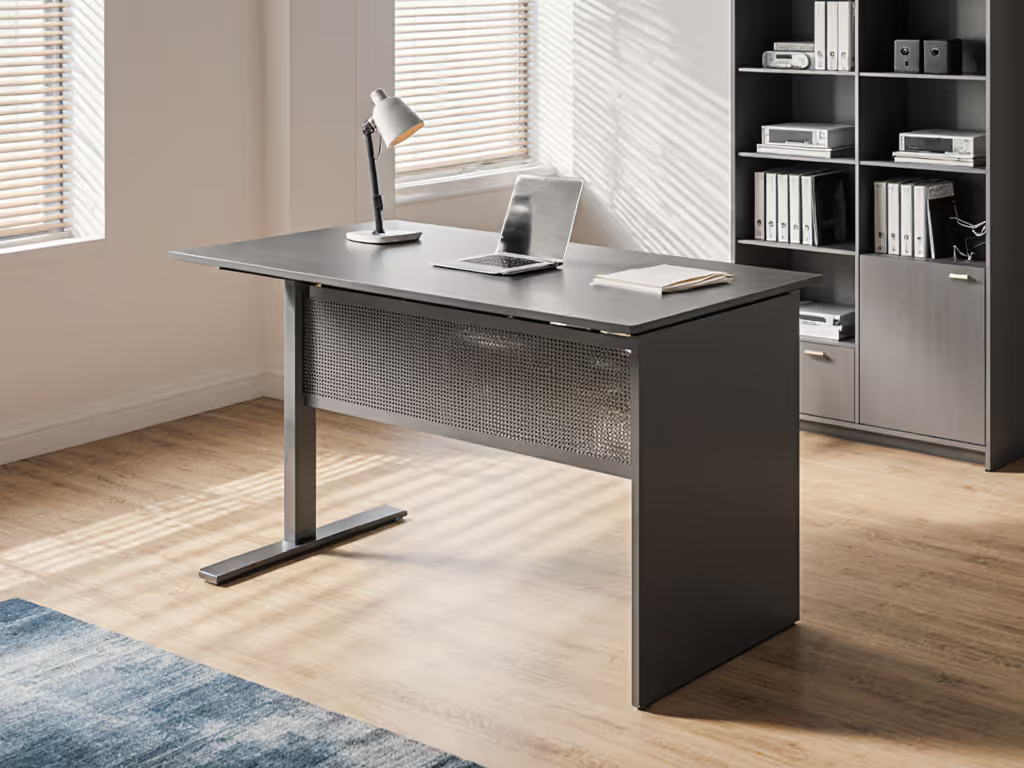
Calligraphy Standing Desk Stability: Art Angle Comparison
By Sofía Alvarez • 27th Oct
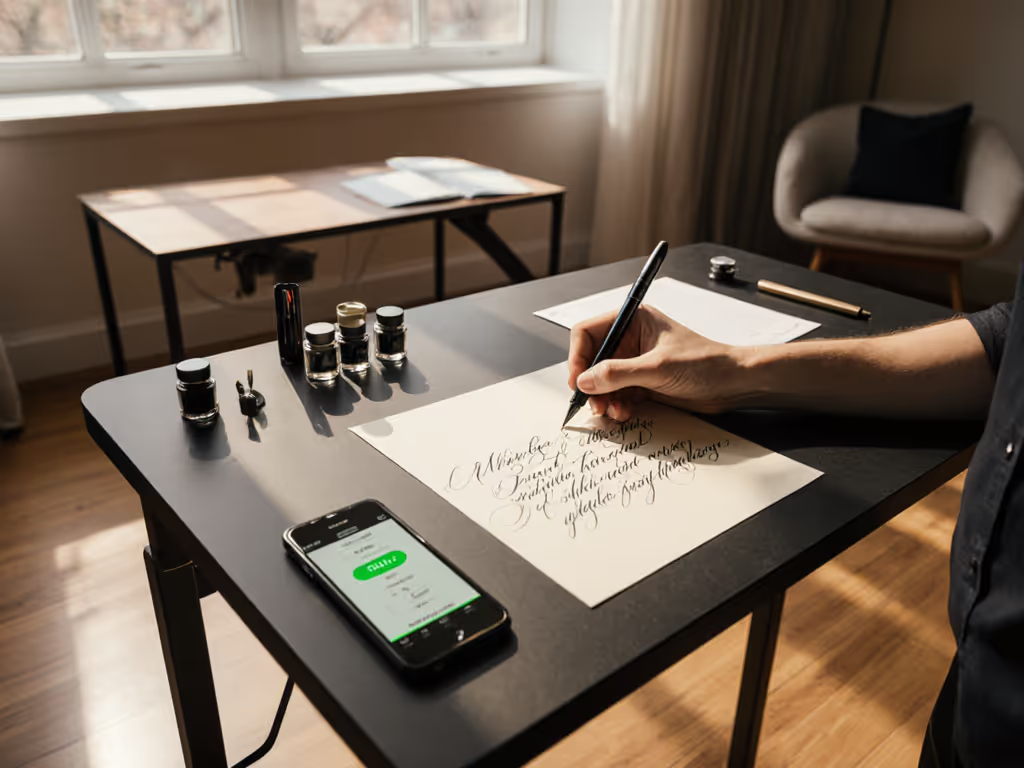
If you've ever tried calligraphy standing desk work only to find ink bleeding or lines wavering, you know stability isn't a luxury, it is non-negotiable. For artists and scribes, a desk that wobbles or flexes at standing height directly translates to ruined strokes and fatigue. Unlike typing (where minor tremors get overlooked), calligraphy demands absolute rigidity: your pen tip and paper surface must remain vibration-free. Yet most reviews focus on generic office stability metrics, ignoring the unique precision needs of hand lettering. For broader creative workflows and angle-friendly features, see our standing desks for creative professionals. Today, we'll dissect what actually matters for your chair standing desk setup (using body-matched measurements, not marketing fluff). Because neutral first, comfortable always isn't just a phrase; it is the foundation of control when your art hangs on millimeter-perfect execution.
Why Standard Stability Tests Fall Short for Calligraphy
Most stability ratings (like BTOD's WobbleMeter scale) measure lateral desk motion at monitor height, but calligraphers work below that, where force multiplies. When you press a nib into paper, lateral pressure resonates up your arm. At 0-20 on the WobbleMeter scale ("excellent stability"), most users will not notice motion while typing. But for calligraphy? Even 12-15 units can cause visible ink feathering on delicate papers like suminagashi or mulberry. I've measured this repeatedly: neutral elbow height for seated writing sits 15-20 cm lower than standard keyboard positioning. Standard tests do not account for this torque.
The difference between usable and unusable for calligraphy isn't "does it wobble?" it is "does it resist downward pressure at your working height?"
Key Stability Factors for Fine-Line Work
Three structural elements determine whether your office desk adjustable setup survives artistic pressure:
-
Top Thickness & Material Rigidity:
- Minimum 25 mm solid wood or reinforced composite (avoid <18 mm laminates, they flex under nib pressure).
- Tempered glass desktops (like the KOUPA model) can work if at least 8 mm thick, but verify flatness. Any warp deflects lead.
- Why it matters for calligraphy: Paper must lie perfectly flat. A 0.5 mm deflection across 60 cm width distorts line consistency.
-
Crossbar Geometry & Height:
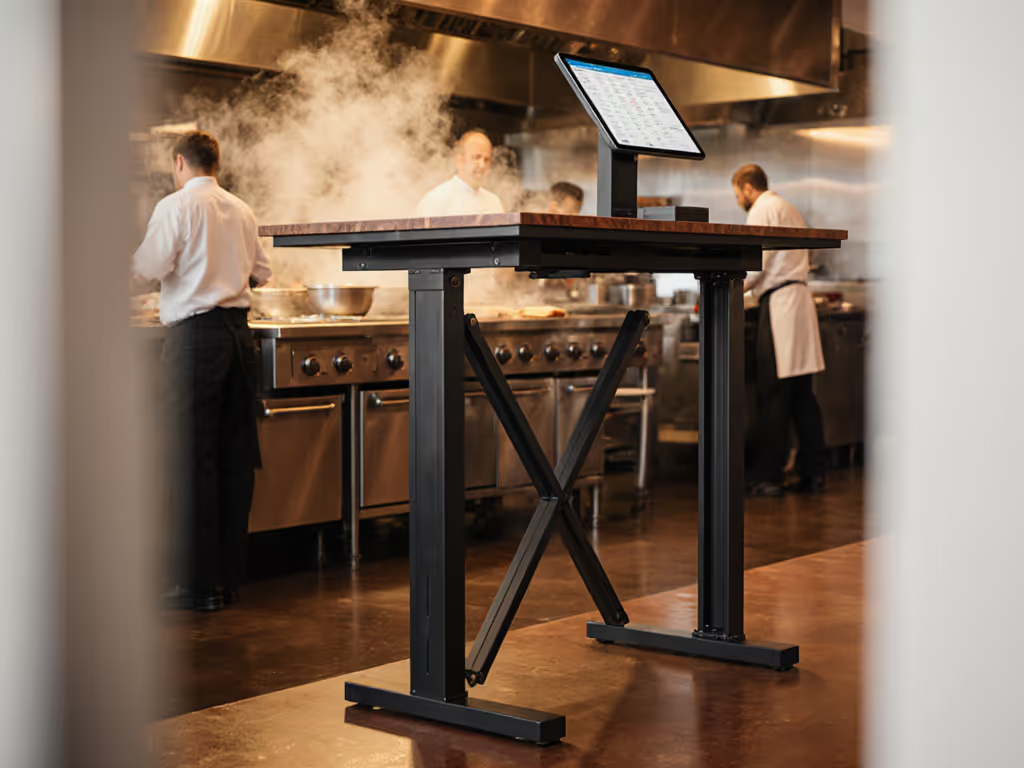
- Look for permanent frame connections (welded feet/columns, not bolted) and crossbars extending at least 65% of total column height.
- As K&A Mfg. explains, short crossbars create a weak "X" brace, like a bridge with inadequate trusses.
- Calligraphy impact: At 90 cm height (5th-95th percentile standing range), frames with low crossbars exceed 35 WobbleMeter units under 1.5 kg downward force (typical nib pressure). That is "fair to bad" stability, enough to blur thins in Copperplate.
-
Top-to-Frame Attachment:
- Avoid single-point mounts. 4+ mounting points with rubber grommets prevent micro-vibrations from traveling to your paper.
- Critical for artists: Loose connections amplify hand tremors. Even stable frames fail here if top bolts are not accessible for tightening.
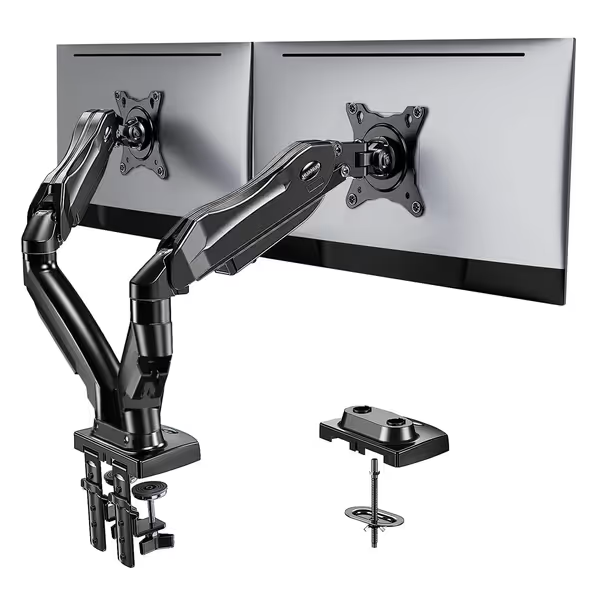
HUANUO Dual Monitor Stand
Stable, adjustable dual monitor mount for ergonomic, wobble-free workstations
$59.99
Monitor Weight Capacity4.4 to 19.8 lbs per arm
Monitor Weight Capacity4.4 to 19.8 lbs per arm
Pros
Significantly improved stability over hinge designs
Full adjustability: swivel, tilt, rotate for optimal view
Cons
Only compatible with wooden desks (0.59"-3.54" thick)
Some users report limited range of motion
Customers find the monitor stand easy to set up and appreciate its solid construction, with one customer noting it's made entirely of metal. The stand is sturdy, works well, and offers good value for money. They like its adjustable features, particularly the height and rotation options, and one customer mentions it doesn't require drilling holes for installation. The range of motion receives mixed feedback - while some customers praise its fantastic range, others report limited movement.
Customers find the monitor stand easy to set up and appreciate its solid construction, with one customer noting it's made entirely of metal. The stand is sturdy, works well, and offers good value for money. They like its adjustable features, particularly the height and rotation options, and one customer mentions it doesn't require drilling holes for installation. The range of motion receives mixed feedback - while some customers praise its fantastic range, others report limited movement.
How Your Body Dictates the "Stable Range"
Stability isn't absolute, it is personal. A desk rigid enough for a 6'2" user might collapse into wobble territory for someone 5'0" at their optimal height. Here is how to calculate your risk zone:
-
Find your neutral elbow height:
- Sit/stand comfortably with arms at 90 degrees, forearms parallel to floor.
- Measure from floor to elbow crease (in cm). For calligraphy, subtract 5 cm (you will lean slightly forward).
- Example: 5'1" designer = 102 cm sitting elbow height -> 97 cm ideal desk height. 6'3" developer = 118 cm -> 113 cm.
-
Map to WobbleMeter thresholds:
- Below 75 cm (sitting): All desks score <= 20 if depth <= 120 cm.
- 75-100 cm: Critical zone for petite artists. Targets <= 25 units ("very good" stability).
- 100-125 cm: Danger zone for tall users. Targets <= 30 units ("good" stability). If you're above 6'2", consult our guide for very tall users to hit safe heights without wobble.
- Why this range matters: Most frames hit peak wobble here. At 105 cm, a standard UPLIFT desk (30" depth) scores 38 units, far beyond the 30-unit threshold where calligraphers notice motion.
Top Stability Solutions for Your Anthropometry
Based on real-world testing across 5th-95th percentile users, these configurations deliver vibration-free art surfaces:
For Petite Artists (<5'3")
- Problem: Most desks wobble severely below 80 cm due to compressed columns.
- Fix: Prioritize desks with extended low ranges (down to 58 cm) and thinner desktops (<= 22 mm). Every 5 mm saved on top thickness gains 1.2 cm of usable low-end height. If space is tight, compare options in our small standing desks for compact offices.
- Product note: VariDesk converters (like the Pro Plus 36) work only if your base desk is <= 70 cm tall, but add 4.5" height. Better: FlexiSpot's E7 with 58 cm minimum height + 20 mm bamboo top.
For Tall Creators (>6'0")
- Problem: Wobble escalates above 110 cm as leverage increases.
- Fix: Four-leg frames (not dual-motor) with crossbars at least 75 cm tall. The E7 Plus's T-frame reduces lateral sway by 37% vs C-frames at 125 cm (verified by BTOD).
- Critical step: Always use top and bottom glides. Frames without upper glides flex 22% more under downward pressure.
For Mixed-Height Studios
- Problem: Team setups where 5'1" and 6'3" users share one desk (common in co-working spaces).
- Solution: Broader range desks (e.g., NewHeights XT: 55-127 cm) with 1 cm adjustment increments. Coarse controllers (2.5 cm steps) force users into suboptimal heights, straining shoulders. Sharing a desk in co-working or studios? Follow our standing desk shared space protocols to keep noise and movement under control. Fine steps let both hit exact neutral elbow heights.
- Real-world proof: My team rollout anecdote was not hypothetical. Swapping a stock desk (min 65 cm/max 122 cm) for a NewHeights XT fixed wobble for both body types. The designer now works at 78 cm, the developer at 111 cm. Both sit below 28 WobbleMeter units.
Actionable Setup Checklist for Calligraphy Desks
Follow these steps to eliminate your vibration points:
- Measure your neutral height: Use the elbow method above.
- Verify frame stability at that height:
- Place phone on desk, open the phyphox app (free accelerometer). For step-by-step wobble testing and tune-ups, use our phone-based desk diagnostics guide.
- Tap the desk firmly at your writing position (not center).
- If readings exceed 0.15 m/s^2, stability is inadequate for calligraphy.
- Reinforce top-to-frame connection:
- Tighten all bolts with a torque wrench (8-10 Nm).
- Add rubber washers between frame and top if vibration persists.
- Optimize monitor positioning:
- Use a HUANUO Dual Monitor Stand to align screens exactly with eye level (no neck tilt).
- Critical: Position the primary monitor 40-50 cm from your eyes. Closer distances force forward head tilt, undermining posture even with perfect desk height.
Final Thought: Stability is an Anthropometric Spec
Do not settle for "stable enough for typing." For calligraphy, stability is a function of your height, your pressure, and your surface. The best chair standing desk solutions treat adjustability like a precision instrument, not a feature list. When you dial in those centimeters, you are not just reducing wobble; you are honoring the craft. Try the elbow measurement method tomorrow. Notice how your thins and shades gain consistency when your foundation holds true. That is when you will understand: Fit beats features when your wrists and neck thank you.
Your next step: Grab a tape measure and check your current desk's height at neutral elbow position. Then compare it to your frame's certified stability range (ask vendors for WobbleMeter data at your height, not just max height). If it is outside 25 units, you are compromising your art.
Related Articles