Balcony Workstation: Weatherproof Standing Desk Comparison
By Sofía Alvarez • 18th Nov
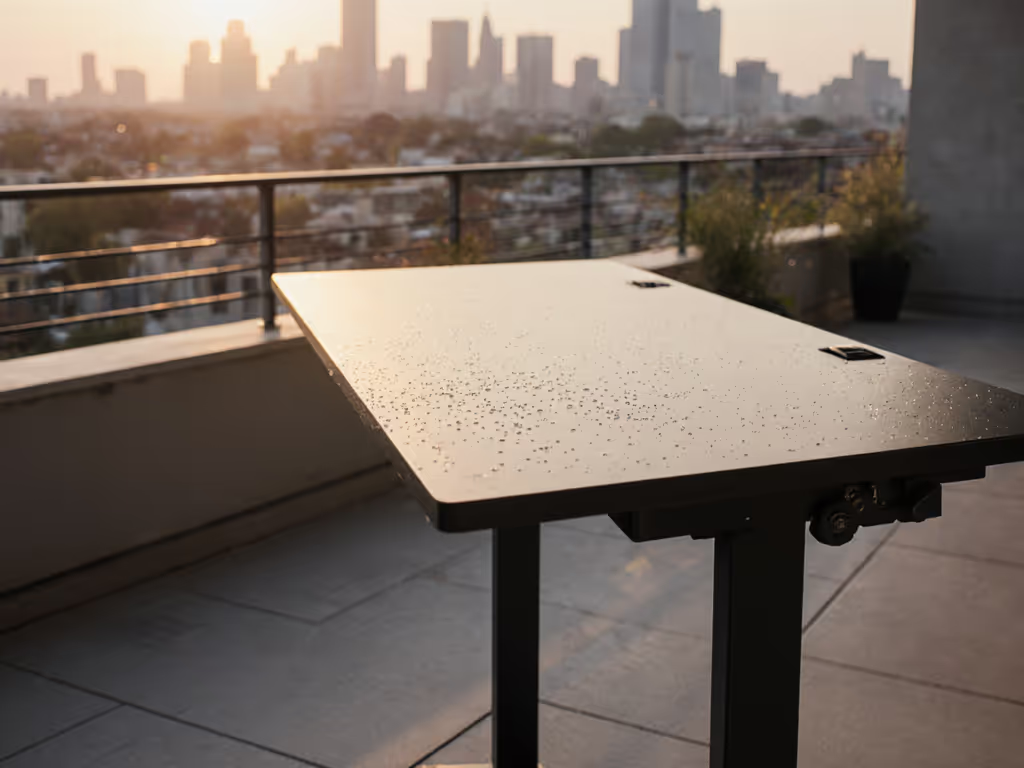
Creating the ideal balcony workstation requires careful consideration of both anthropometrics and environmental factors. For knowledge workers seeking to optimize their outdoor workspace, the right combination of chair, standing desk, and portable standing desk becomes essential for maintaining neutral posture in varied weather conditions. This guide compares weatherproof standing desk solutions through the lens of body-specific fit requirements, rather than merely listing features. For precise monitor, keyboard, and mouse placement, see our standing desk ergonomics guide. As I've observed while measuring countless workspaces, fit beats features when your wrists and neck thank you.
Understanding Your Body Dimensions First
Before evaluating balcony workstation options, establishing your personal anthropometric boundaries is critical. The difference between 5th and 95th percentile users spans 30+ cm in elbow height (far beyond what most "one-size-fits-all" standing desks accommodate). When a 5'1" designer and 6'3" developer share the same space, the "standard" height range often fails both.
Neutral first, comfortable always: this principle should drive your entire balcony workstation selection process.
Consider these body measurements before shopping:
- Elbow height in seated position: Measure from floor to elbow while seated with arms at 90 degrees (typically 23-31 cm for 5th-95th percentile women, 25-34 cm for men)
- Shoulder height standing: Measure from floor to shoulder while standing relaxed (typically 125-150 cm)
- Eye height standing: Measure from floor to pupil center while standing (typically 145-172 cm)
- Thigh clearance: Measure from seat to underside of desk needed for comfortable leg positioning (typically 22-28 cm)
These measurements translate directly to your balcony workstation specifications. For example, a user with 28 cm seated elbow height needs a desk surface at precisely this height for neutral keyboard positioning (no higher, no lower).
Critical Questions for Weatherproof Standing Desks
What makes a desk truly weatherproof for balcony use?
Many "weather-resistant" desks use indoor-rated components that degrade quickly when exposed to moisture and UV radiation. True weatherproofing requires:
- Frame materials: Marine-grade aluminum (6061-T6 or better) with powder-coated finish rated for outdoor use
- Electronics: IP54-rated motor and controller (minimum) with conformal coating on circuit boards
- Surface materials: Teak, HDPE plastic, or marine-grade plywood with marine varnish
- Hardware: Stainless steel (304 or 316 grade) screws and fasteners
Indoors-rated desks often fail within 6-12 months on balconies due to humidity affecting the motors and electronics. True weatherproof desks maintain height adjustment precision within ±1.5mm across 5,000+ cycles in 80% humidity conditions.
How much height range do I actually need for proper ergonomics?
While many manufacturers advertise "24-50 inch" ranges, the usable range for precise ergonomic fit is often narrower. The key metric is step increment size: desks with 1mm increments allow precise dialing to your exact elbow height, while those with 1cm steps force compromise.
For balcony workstation configuration:
- Petite users (<5'3"): Require minimum seated height of 22-24" (56-61 cm)
- Average users (5'3"-5'11"): Need seated height of 24-27" (61-69 cm)
- Tall users (>6'): Demand seated height up to 28-30" (71-76 cm)
I've found that even "height-adjustable" desks often miss critical ranges, especially for seated positions of taller users and standing positions of petite users. The ideal balcony workstation covers 22-52" (56-132 cm) with increments ≤1mm. This range accommodates 5th-95th percentile users across seated and standing postures.
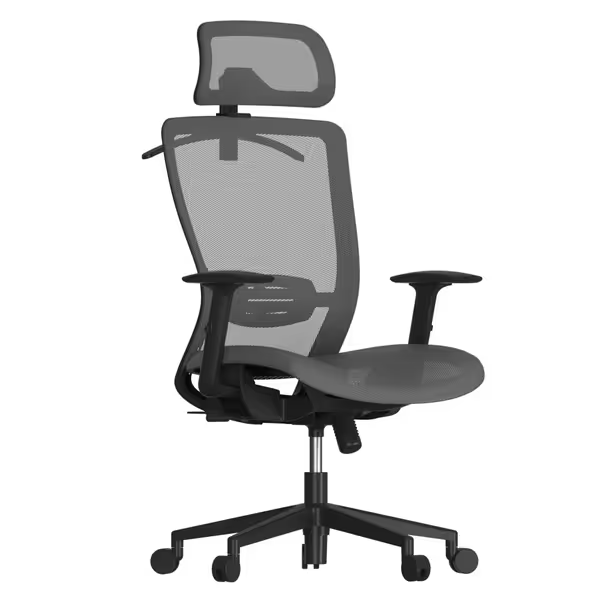
FLEXISPOT Ergonomic Office Chair OC3
Ergonomic chair for all-day comfort and support across diverse settings.
$139.99
Weight Capacity300 lbs
Weight Capacity300 lbs
Pros
Supports ergonomic posture to reduce fatigue.
High-density mesh keeps you cool and comfortable.
Cons
Lumbar support adjustment may be too low for some.
Mixed feedback on overall material quality.
Customers find the office chair incredibly comfortable, with good back support that helps prevent slouching, and they appreciate its solid construction and value for money. The chair is easy to assemble, and one customer specifically mentions the adjustable lumbar support that contours well to the lower back. The material quality receives mixed feedback - while the mesh material is wonderful, some customers note that the lumbar adjustment is laughably low.
Customers find the office chair incredibly comfortable, with good back support that helps prevent slouching, and they appreciate its solid construction and value for money. The chair is easy to assemble, and one customer specifically mentions the adjustable lumbar support that contours well to the lower back. The material quality receives mixed feedback - while the mesh material is wonderful, some customers note that the lumbar adjustment is laughably low.
What chair considerations matter specifically for balcony work?
Your chair and standing desk pairing requires special attention for outdoor environments. Standard office chairs suffer from UV degradation, moisture absorption, and stability issues on uneven surfaces.
For balcony workstation chair selection:
- Frame durability: Aluminum or powder-coated steel (avoid plastic components)
- Seat material: Quick-dry mesh or marine vinyl (not standard foam/mesh which retains moisture)
- Weight capacity: At least 300 lbs to accommodate summer clothing layers
- Height range: Minimum 16"-22" (40-56 cm) seat height adjustment
- Base stability: 5-point base with minimum 28" (71 cm) diameter
The FLEXISPOT OC3 ergonomic chair mentioned above provides excellent breathability for warm conditions while maintaining proper lumbar support. Its tool-free adjustments allow quick posture tweaks as conditions change throughout the day.
How do I ensure stability on uneven balcony surfaces?
Most balconies have slight gradients (typically 1-3 degrees) that dramatically affect standing desk stability. Traditional indoor desks with fixed-height legs become unstable or wobble excessively when placed on sloped surfaces.
For true balcony workstation stability:
- Independent leg height adjustment: At least 2" (5 cm) per leg for leveling
- Dual-motor systems: Provide better synchronization than single-motor setups on uneven surfaces
- Base width: Minimum 24" (61 cm) front-to-back for standing stability
- Crossbar design: Avoid "X" shaped crossbars that interfere with knee clearance
Measure your balcony's slope with a digital level before purchasing. For troubleshooting wobble and uneven lift, follow our diagnostics and maintenance guide. A 2-degree slope requires approximately 1.5" (3.8 cm) height adjustment difference between front and back legs for a 42" deep desk.
What electrical considerations exist for outdoor workstations?
Unlike indoor setups, balcony workstation power management requires careful planning:
- Power source: Minimum 6A circuit within 3 feet (0.9m) of desk location
- Cable protection: UV-resistant conduit for permanent installations
- Grounding: GFCI outlet required within 6 feet (1.8m) of desk
- Controller placement: Elevated at least 4" (10 cm) above surface to prevent moisture ingress
The ideal electric office desk for balcony use includes a controller with Bluetooth connectivity, allowing height adjustment via smartphone when the physical controller becomes damp or difficult to reach. To minimize outdoor cable clutter, consider a desk with integrated 100W USB-C charging.
Practical Implementation Framework
When configuring your balcony workstation, follow this measurement-based approach:
- Determine your neutral posture measurements (as outlined above)
- Measure your balcony dimensions including slope, sun exposure, and power access points
- Calculate required desk height range with 1cm buffer above/below your measured needs
- Verify weatherproofing specifications match your local climate conditions
- Test stability with your chair before finalizing purchase
A properly configured balcony workstation should maintain your neutral posture across all working positions while withstanding local weather conditions. I've seen too many professionals purchase "premium" standing desks only to discover they can't achieve neutral elbow height, either seated or standing.
Actionable Next Steps
Before shopping for your balcony workstation, take these precise measurements:
- Measure your seated elbow height (with your preferred chair) to the nearest millimeter
- Measure your standing eye height to determine monitor positioning
- Calculate your required desk height range: seated elbow height ± 2cm for keyboard/mouse adjustment
- Measure your balcony's slope with a digital level
- Determine power access points and distances
With these measurements in hand, you can objectively evaluate whether a "portable standing desk" genuinely fits your anthropometrics rather than accepting marketing claims about "universal fit." If space is limited, compare a converter vs full desk using our 10-year total cost analysis. Remember that good ergonomics is precise accommodation, not one-size-fits-all accessories. Your balcony workstation should adapt to your body, not force your body to adapt to it.
The weatherproof desk that serves you best isn't the one with the most features, but the one that delivers your exact height requirements with precision and stability in your specific environment. Neutral first, comfortable always: this principle transforms your balcony from a pleasant workspace into a productivity sanctuary.
Related Articles